
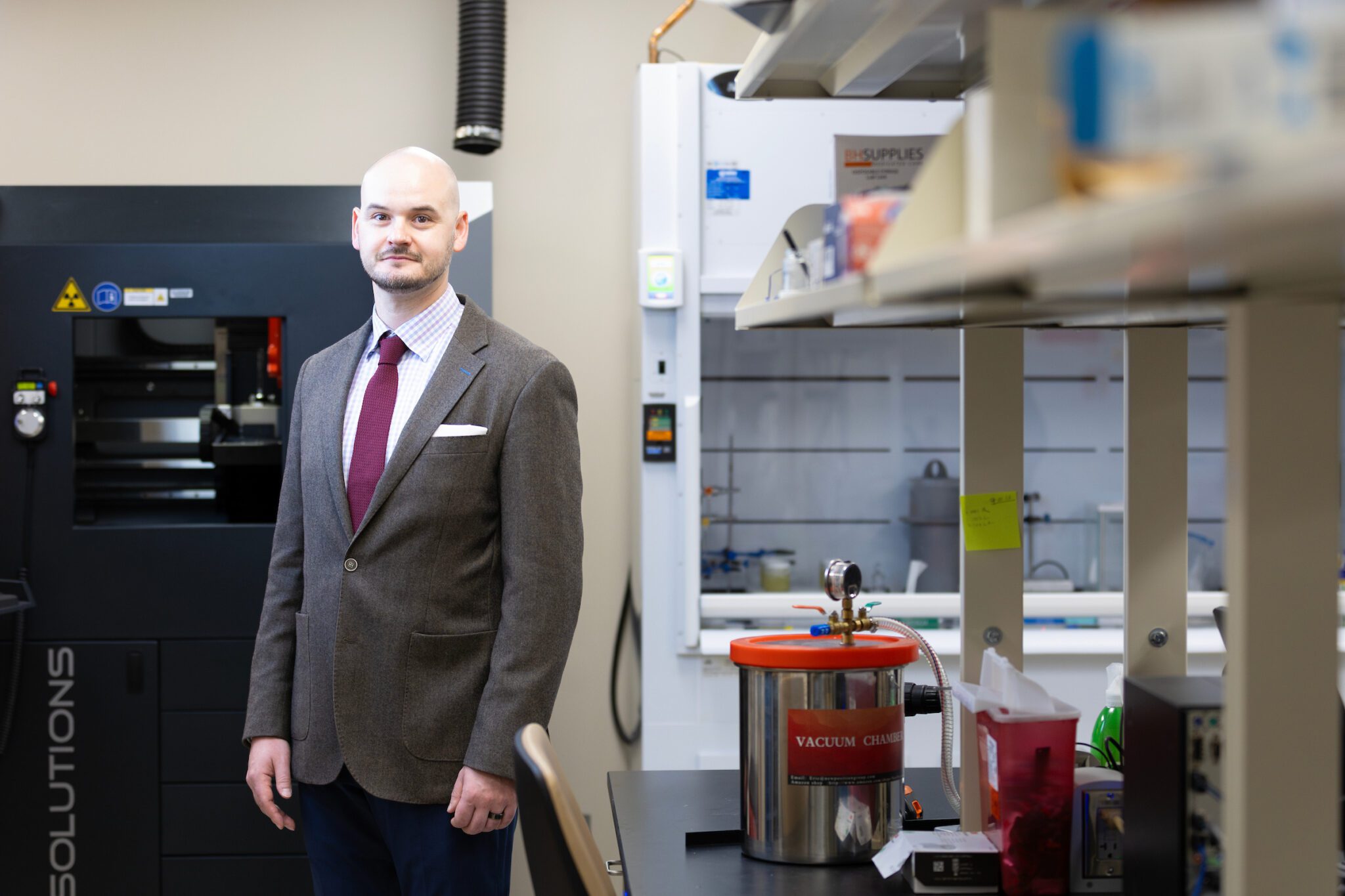
A $2.7 million NIH grant is supporting the development of the first therapy that can directly remove arterial calcification and improve blood flow in patients with peripheral artery disease.
by SAM PESHEK
UNO Director of Editorial and Media Relations
Peripheral artery disease (PAD) affects more than 200 million people, and over 70% of them develop calcium deposits in their leg arteries – lesions that complicate every treatment and quadruple the risk of amputation. Yet no current therapy can remove this hardened calcium.
A team led by the University of Nebraska at Omaha’s Department of Biomechanics – working in collaboration with vascular surgeons at the University of Nebraska Medical Center and scientists at Virginia Tech – is aiming to change that.
The team led by Alexey Kamenskiy, Ph.D., director of UNO’s Center for Cardiovascular Research in Biomechanics, has received a $2.7 million National Institutes of Health (NIH) R01 grant to develop a first-of-its kind local treatment for peripheral artery disease (PAD).
“Our goal is to give physicians a safe, targeted way to remove arterial calcium and restore vessel compliance –– something current treatments can’t achieve,” Kamenskiy said.
Researchers at the University of Nebraska Medical Center (UNMC) and Virginia Tech are partnering with UNO to test whether a localized EDTA chelation therapy can safely remove arterial calcium – a major cause of treatment failure, impaired blood flow and amputation in PAD patients.
“This therapy could be life-changing for patients with severe PAD, offering a new, targeted method to improve artery function and prevent amputations,” Jason N. MacTaggart, M.D., FACS, Professor, UNMC Department of Surgery, said.
Current PAD treatments — including angioplasty, stenting, bypass surgery and atherectomy – can improve blood flow, but none can remove the hardened calcium embedded in the arterial wall.
The team’s approach uses a microneedle catheter to deliver EDTA directly into the calcified arterial wall, targeting the calcium itself rather than working around it. If successful, the project could enable the first therapy capable of directly removing arterial calcium and restoring vessel flexibility – a shift that could dramatically improve outcomes for patients with calcific PAD.