
by KARA SCHWEISS
While others may dismiss insects as expendable and mere pests, Oklahoma City Zoo and Botanical Garden Conservation Scientist Dr. Emily Geest recognizes the essential role they play in ecosystems from pollination to decomposition to serving as a food source for other animals, making them indispensable for biodiversity and human survival.
“There’s this famous stat people say, that one out of every three bites of food is due to a pollinator,” Geest said. “We’re not on our own. We’re part of this system, and so if you don’t preserve this system, it will negatively impact us. If we lose our pollinators, we increase our food insecurity.”
Geest’s area of expertise is insect conservation and ecology. Before going on to earn her Ph.D. at Oklahoma State University, The St. Louis native received her master’s degree in biology at UNO, studying at the university from 2015 to 2017.
“I joined the ‘McWolf” lab — John McCarty and LaReesa Wolfenbarger’s lab — and that’s where I did my master’s work with monarchs,” Geest said. Both professors are associated with UNO’s department of biology; Wolfenbarger is chair and McCarty serves as director of the environmental studies program.
“I’m really proud of my project I did in Omaha. That’s where I switched from studying birds to studying butterflies,” Geest said, adding that she compared how monarchs were using gardens versus natural prairies and observed their survival to adulthood rate and health. Her work with the species continues at the Oklahoma City Zoo, like spearheading a project to find and support rare varieties of milkweed, an important food source for monarchs, or tagging the tiny creatures and tracking their annual migration to overwinter in Mexico.
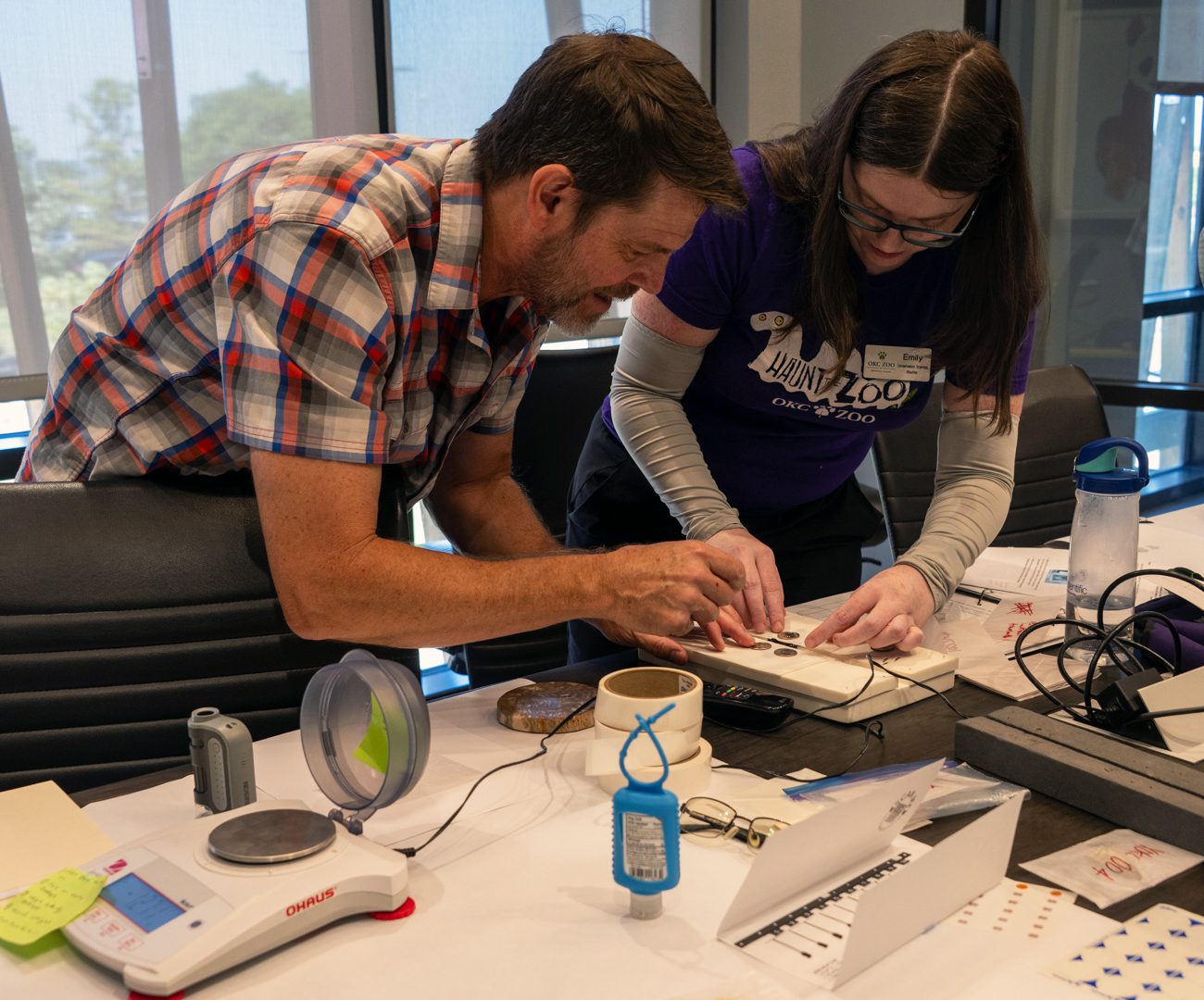
“(The tags) are so tiny, they’re about the size of your pinky fingernail, and you attach them to the monarch very carefully with eyelash glue, non-toxic,” she said. “It’s very precarious, so it takes just a little bit of maneuvering.”
Geest works with other insects including dragonflies, bees and fireflies, the latter being the focus of her August 2025 TED talk “Mood lighting, mating, and murder: The scintillating lives of fireflies.” She is also inspiring future conservationists and building awareness of ecology through her participation in living classroom programs. Like a microcosm of the earth’s biosphere itself, these and many other contributions of Geest’s are all part of the larger effort by the Oklahoma City Zoo — and beyond — to preserve species worldwide.
In late 2025, Geest was named a United Nations Association-United States of America Global Goal Ambassador for SDG Life on Land. SDGs (sustainable development goals) are part of the 2030 Agenda for Sustainable Development adopted by all United Nations member states in 2015. There are 17 SDGs, with ambassadors selected for each one to serve as part of a working-group cohort.
“I’m an ambassador for terrestrial conservation, and that has been really exciting. I’ve been on a meeting with ambassadors from Palau, I’ve been able to speak with UNESCO folks about the importance of monarch conservation,” she said. “It’s been really cool to be part of this think tank of how we can increase conservation.”